
Visibility is not the goal
In reporting and analytics, we have become very good at turning data into dashboards.
In many companies, data and processes are being harmonised across teams, entities and systems. That creates real value. Within minutes, we can get a clear view on working capital drivers, forecast deviation, blocked orders, dispute aging, service levels and other operational metrics. This supports decisions from management down to day-to-day execution.
That is analytics working well. But if I ask where the real ROI comes from, one thing becomes clear: visibility alone is not enough. Value is created when insight leads to action.
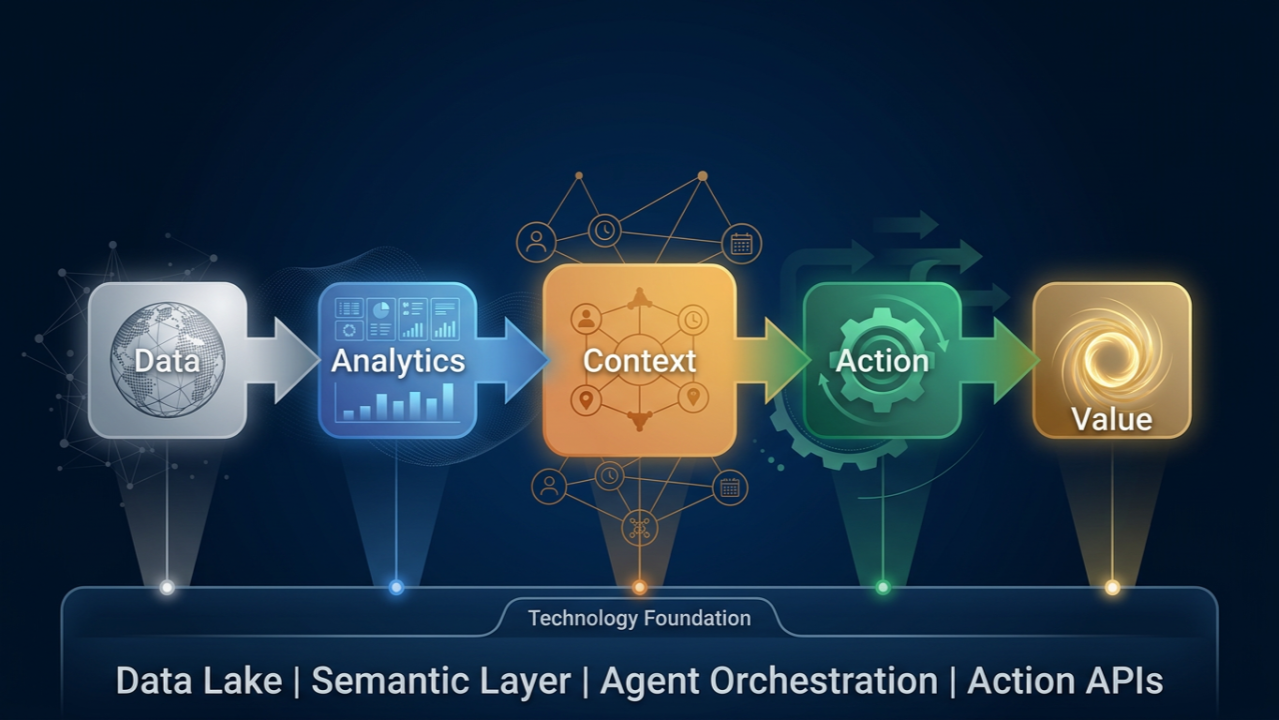
For me, the sequence is clear:Data -> Analytics -> Context -> Action
Data and analytics are already in place in many organisations. Action is the goal. The critical layer in between is context.
Why context makes systems useful
By context, I mean the information a system needs in order to act correctly. It starts with semantics: shared business meaning, clear definitions, relationships between data, and the logic behind a metric. But it also includes rules, ownership, decision boundaries, current process state, and feedback on the result of an action.
That is where many transformation efforts become more interesting. The challenge is usually not getting access to data. The challenge is making the business logic explicit enough that a system can support real work reliably.
I see the same pattern in private work with Claude Code. It becomes much better when it can run tests, inspect logs, see errors and adjust. The model matters, of course. But the real gain comes from context and feedback.
Without that, agentic AI remains limited. It can answer questions, summarise trends and generate options. But once it has to support action inside a real process, missing context becomes a serious problem. Then you get weak decisions, hallucinations, or systems that are active but business-blind.
With the right context, the picture changes. Systems can move from showing the business to supporting or executing parts of it in a controlled way. Not replacing human judgement, but extending it where speed, consistency and scale matter.
Good process design becomes visible
The moment you try to make a process ready for systems or agents, you quickly see how well it is really understood. Different definitions appear. Modelling gaps become visible. Decision logic that worked informally between people often turns out to be too unclear for reliable execution.
That is why I think the organisations moving fastest here are not only investing in platforms. They are also investing in semantics, process clarity and feedback loops.
Where I would start
I would start with one process where the decision context is reasonably clear and the business value is visible. Describe it end to end: the data, documents, rules, constraints, expected outputs, and the action the system may trigger.
Then define how feedback comes back into the process. What happened? Did the action work? Where is approval needed? Where is a human still better?
In my view, the real investment is not the model. It is understanding the process well enough to make action reliable.
Technology has to evolve in parallel
At the same time, the technology design cannot wait until the end. It has to evolve in parallel with the process. The software layer must integrate with existing systems, connect to the right context, support agent design and orchestration, and allow testing, control and feedback.
Why now
The timing matters as well. SAP is making its landscape more agent-ready with Joule and Business Data Cloud, while Salesforceis moving in a similar direction with Headless 360 and agent-first workflows. If analytics becomes broadly available, analytics alone stops being the differentiator.
The advantage will go to the companies that connect data, context and process well enough to move from insight to action first.