Category: Analytics, AI and Process Automation

  • Before We AI

    Before We AI

    I have spent much of my professional life between business, data and enterprise technology.

    One problem keeps returning: producing an answer is often easier than establishing what that answer actually means.

    AI makes producing answers dramatically faster. But before we AI, we need to understand which data is relevant, what it means, which rules apply and who has the authority to decide.

    That thought became the name of my project: before-we-ai.

    It starts with a specific business question and asks:

    What must be true for this answer to deserve trust?

    The system traces the answer back to its sources and assumptions, tests what can be verified and makes visible what still requires a business decision.

    A plausible answer is not necessarily a reliable one

    Imagine a shipbuilder asking:

    What will it cost to build vessel S42?

    The available sources contain a bill of materials, purchase prices, labour hours and overhead rates. AI can combine them and calculate a credible total.

    But which design revision applies? Does “cost” mean expected or actual cost? Is the purchase price the approved costing basis? Are labour hours recorded per vessel or for a production batch? Which overhead rule is current?

    These are not technical details around the answer. They determine what the answer represents.

    A calculation can therefore be correct and still answer the wrong question.

    From data discovery to answer readiness

    The project began as an experiment in understanding unfamiliar business data.

    Modern AI can inspect tables, follow spreadsheet formulas and propose relationships remarkably quickly. I wanted to explore how far this could reduce the effort required to understand a new data landscape.

    But finding a field called Purchase_Price does not establish that it is the price the organisation intends to use for expected costing. Reproducing an existing workbook does not prove that the workbook still follows the approved policy.

    That changed the direction of the project.

    Instead of asking whether AI can understand the data, I began asking:

    What must be true for this particular answer to deserve trust?

    This moves the focus from broad “AI readiness” to the readiness of one intended answer.

    The same data may be adequate for exploration and insufficient for a financial decision. Readiness depends on the intended use and what could happen if the answer is wrong.

    What the draft product looks like

    The first version is deliberately simple.

    A user supplies files or database extracts, asks a business question and clarifies the intended result. The system inspects the sources, establishes what a reliable answer would require and presents a readiness assessment.

    The user should not have to design a semantic model or translate the question into technical language.

    The system asks only the focused questions that the available sources cannot resolve—for example, which BOM revision is approved or whether labour hours apply per vessel or per batch.

    Later, once the answer is sufficiently supported, the product can also execute the final calculation.

    But the calculated number is not the core product.

    The readiness decision is.

    How it works

    It begins with a normal business question:

    What will it cost to build vessel S42?

    Before calculating anything, the system clarifies what the requested answer should mean. Is this expected or actual cost? Should it use the currently approved design? Should the result include overhead?

    It then works backwards from that clarified question and establishes what a reliable answer would require.

    For vessel costing, it needs to know which design applies, which material prices are valid and how labour and overhead should be treated.

    Some of this can come from established domain knowledge. General costing principles provide a starting point and help the system recognise what it should look for.

    More knowledge is discovered in the supplied sources. The system can follow formulas, identify relationships and reconstruct how an existing workbook calculates its result.

    But observation is not the same as approval.

    The fact that a workbook uses Purchase_Price shows how that workbook currently works. It does not establish that Purchase_Price is the company’s approved basis for expected costing.

    Where the sources cannot establish business intent, the system asks a focused question or looks for an authoritative document.

    The result is a growing body of validated knowledge about how this type of answer should be produced in this organisation. Each piece retains its origin, scope and validation status.

    The system then applies that knowledge to the current sources, tests the important dependencies and determines whether the answer is ready.

    In simple terms:

    Ask → Clarify → Establish what a reliable answer requires → Validate the sources → Fill important knowledge gaps → Assess readiness → Answer

    The system does not start from zero each time. Confirmed knowledge can be reused for later questions when its scope still applies.

    This is where the longer-term value begins to emerge: each assessment can improve the organisation’s usable knowledge without pretending to model the entire enterprise in advance.

    The Readiness Map

    The Readiness Map shows how well the requirements for the intended answer are supported.

    It connects what the answer depends on with the available evidence, confirmed business knowledge and unresolved gaps.

    Executable checks can establish that identifiers match across files, formulas reproduce recorded totals or two sources contradict each other.

    They cannot decide which source or rule the organisation intends to use.

    That distinction remains visible in the result.

    The readiness decision is intentionally not expressed as a percentage. “83% trustworthy” would imply a precision the system does not have.

    Instead, the assessment gives one of three controlled outcomes:

    • Ready — all material dependencies are sufficiently supported.
    • Ready with limitations — a clearly defined, narrower answer is justified.
    • Blocked — an unresolved dependency could materially change the answer.

    “Ready with limitations” must mean something precise. In the vessel example, the permitted answer might exclude overhead because no valid overhead rule has been established.

    If the selected material-price basis remains unconfirmed and could materially change even that narrower result, the correct decision is blocked.

    Stopping is therefore not a failed run. It is a useful result when the available evidence does not justify greater confidence.

    What the system learns

    The knowledge used by before-we-ai comes from sources with different levels of authority.

    Established domain knowledge provides general principles. For example, material cost depends on component quantities and an applicable price.

    Source inspection reveals how the available files and systems appear to work. It may show that a workbook calculates material cost by multiplying BOM quantity by purchase price.

    Organisational knowledge establishes what the company intends. An approved policy or authorised person may confirm which BOM revision and price basis must be used.

    These statements are related, but they are not interchangeable:

    Observed: The workbook uses Purchase_Price.

    Confirmed: Purchase_Price is the approved basis for expected vessel costing.

    AI can discover the first statement. It cannot safely authorise the second.

    Confirmed knowledge is therefore stored together with its source, scope and validity. A rule applying to expected costing for one vessel family should not silently become a universal company rule.

    Over time, this creates a reusable knowledge base grounded in actual business questions and validations.

    The architecture, briefly

    The first implementation uses one AI agent. The essential design choice is the separation of responsibilities around it.

    AI interprets the question, proposes possible meanings and determines what should be checked.

    Executable components inspect schemas, extract spreadsheet formulas, run SQL and perform reconciliations.

    Approved documents or people with the relevant authority establish what the organisation intends.

    The readiness layer decides what the available support permits the system to claim.

    The high-level flow is:

    Business question
    → clarify the intended answer
    → establish what a reliable answer requires
    → inspect the available sources
    → propose meanings and checks
    → collect evidence and confirmation
    → assess readiness
    → produce, limit or block the answer

    The principle behind this architecture is simple:

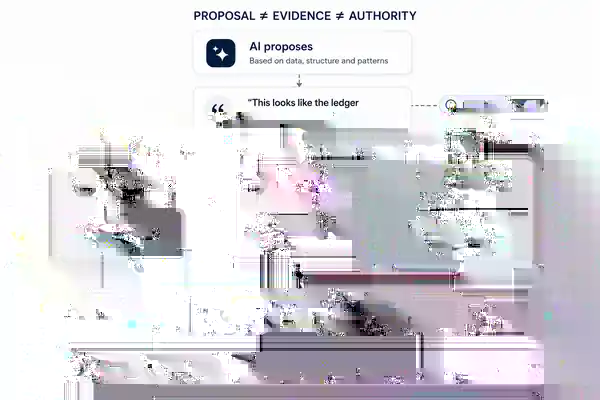
    The model may propose. Evidence may demonstrate. Authority establishes intent. Readiness controls the answer.

    What this could become

    The immediate goal is modest: demonstrate one complete answer path using a realistic business question and a limited set of sources.

    A meaningful result would not merely produce a vessel-cost total. It would be able to say:

    I can reproduce the number in the workbook, but I cannot yet confirm that it represents the current approved expected cost.

    It should then identify exactly what is missing, why it matters and how the gap can be resolved.

    If this works with real data, before-we-ai could sit between enterprise data and AI applications as an answer-readiness control layer.

    Reports, analytics tools and agents could consume an answer together with its readiness status, evidence and limitations.

    It would complement data platforms, catalogues and semantic models rather than replace them. Those systems organise data and context at scale.

    before-we-ai makes a narrower decision:

    Is the available context sufficient for this particular answer?

    Each resolved question can add scoped, reusable organisational knowledge. The knowledge base grows through actual work rather than through an attempt to describe the entire enterprise in advance.

    Why I am building it

    before-we-ai brings together the areas in which I have worked for many years: finance, enterprise data, reporting and transformation.

    It also reflects what interests me most about AI.

    The opportunity is larger than producing answers faster. AI can help expose how business knowledge is distributed and where apparently settled calculations still depend on unspoken assumptions.

    But plausible reasoning and justified confidence remain different things.

    Capability is not authority, and plausible reasoning is not evidence.

    before-we-ai is my attempt to turn that distinction into a working system.

    This was not my first AI-supported project, but it was the most complex so far—and the first time the process genuinely felt like working with a development partner. That experience depended heavily on learning how to use agents effectively: matching the model and reasoning level to the task, choosing the right execution environment, and balancing speed against limited credits. Claude Fable and GPT-5.6 Sol made that shift especially tangible.

    The next step is a small real-world test: one meaningful question, the sources currently used to answer it, and an honest decision about whether the result deserves trust.

    Feedback and co-work wellcome

    The project is open on https://github.com/happychriss/before-we-ai/—feedback, contributions, and sharing are very welcome.

  • From Dashboards to Action: The Missing Context Layer in Analytics

    From Dashboards to Action: The Missing Context Layer in Analytics

    Visibility is not the goal

    In reporting and analytics, we have become very good at turning data into dashboards.

    In many companies, data and processes are being harmonised across teams, entities and systems. That creates real value. Within minutes, we can get a clear view on working capital drivers, forecast deviation, blocked orders, dispute aging, service levels and other operational metrics. This supports decisions from management down to day-to-day execution.

    That is analytics working well. But if I ask where the real ROI comes from, one thing becomes clear: visibility alone is not enough. Value is created when insight leads to action.

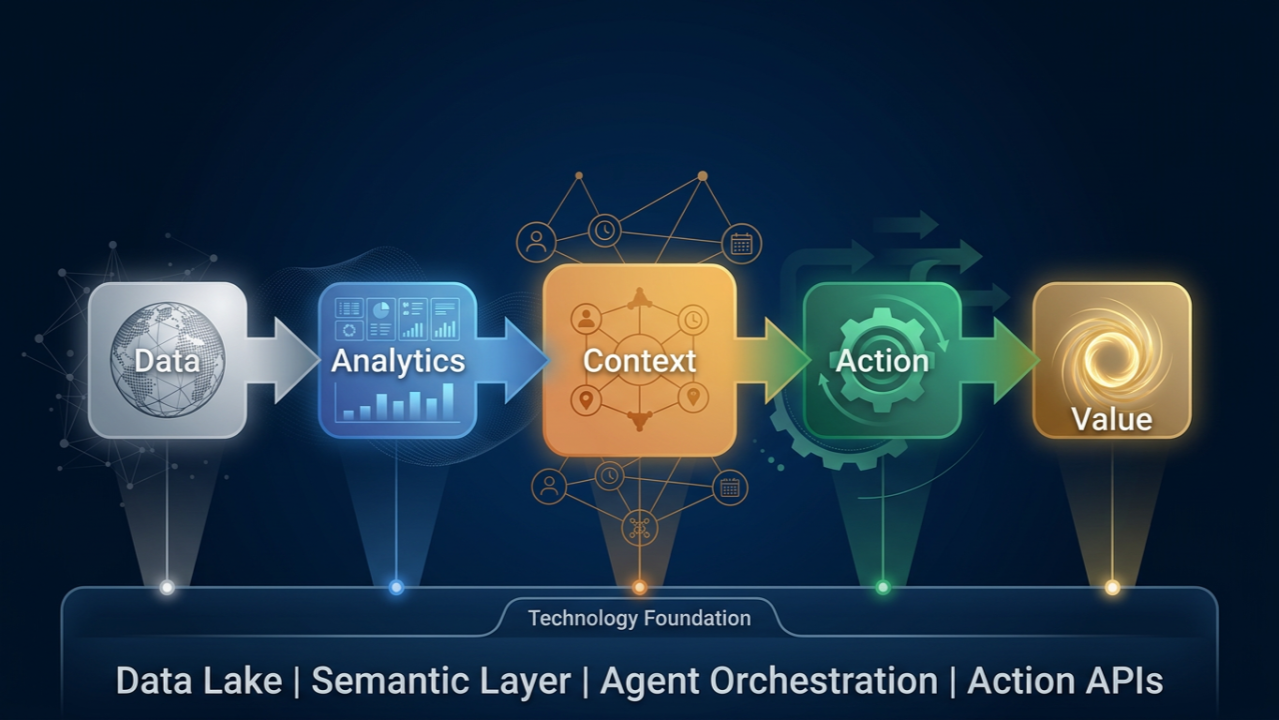
    For me, the sequence is clear:Data -> Analytics -> Context -> Action

    Data and analytics are already in place in many organisations. Action is the goal. The critical layer in between is context.

    Why context makes systems useful

    By context, I mean the information a system needs in order to act correctly. It starts with semantics: shared business meaning, clear definitions, relationships between data, and the logic behind a metric. But it also includes rules, ownership, decision boundaries, current process state, and feedback on the result of an action.

    That is where many transformation efforts become more interesting. The challenge is usually not getting access to data. The challenge is making the business logic explicit enough that a system can support real work reliably.

    I see the same pattern in private work with Claude Code. It becomes much better when it can run tests, inspect logs, see errors and adjust. The model matters, of course. But the real gain comes from context and feedback.

    Without that, agentic AI remains limited. It can answer questions, summarise trends and generate options. But once it has to support action inside a real process, missing context becomes a serious problem. Then you get weak decisions, hallucinations, or systems that are active but business-blind.

    With the right context, the picture changes. Systems can move from showing the business to supporting or executing parts of it in a controlled way. Not replacing human judgement, but extending it where speed, consistency and scale matter.

    Good process design becomes visible

    The moment you try to make a process ready for systems or agents, you quickly see how well it is really understood. Different definitions appear. Modelling gaps become visible. Decision logic that worked informally between people often turns out to be too unclear for reliable execution.

    That is why I think the organisations moving fastest here are not only investing in platforms. They are also investing in semantics, process clarity and feedback loops.

    Where I would start

    I would start with one process where the decision context is reasonably clear and the business value is visible. Describe it end to end: the data, documents, rules, constraints, expected outputs, and the action the system may trigger.

    Then define how feedback comes back into the process. What happened? Did the action work? Where is approval needed? Where is a human still better?

    In my view, the real investment is not the model. It is understanding the process well enough to make action reliable.

    Technology has to evolve in parallel

    At the same time, the technology design cannot wait until the end. It has to evolve in parallel with the process. The software layer must integrate with existing systems, connect to the right context, support agent design and orchestration, and allow testing, control and feedback.

    Why now

    The timing matters as well. SAP is making its landscape more agent-ready with Joule and Business Data Cloud, while Salesforceis moving in a similar direction with Headless 360 and agent-first workflows. If analytics becomes broadly available, analytics alone stops being the differentiator.

    The advantage will go to the companies that connect data, context and process well enough to move from insight to action first.

  • ChatGPT and Data Analytics: Early Lessons from Finance Reporting

    ChatGPT and Data Analytics: Early Lessons from Finance Reporting

    How ChatGPT is Changing the Game in Data Analytics!

    This weekend, I had the opportunity to subscribe to “ChatGPT Plus.” I spent some time exploring how AI, like ChatGPT, will change the way we work with our data.

    Currently, I am working on a large enterprise financial transformation project. So – why not starting with a simple order intake to end-up getting the Profit & Loss statement from ChatGPT?

    The results were astonishing, which made me wonder if we should rethink the way we do data and analytics?

    When reading  through my chat with ChatGPT3  – best first to look at the screenshots and than reading my comments. I have described each steps, all  screenshots are all from the same conversation.

    At the end of my summary, I will try to look ahead 1-2 years and determine what kind of decisions we can make based on this understanding.

    A real world scenario from “Selling Bananas” to “Profit and Loss”

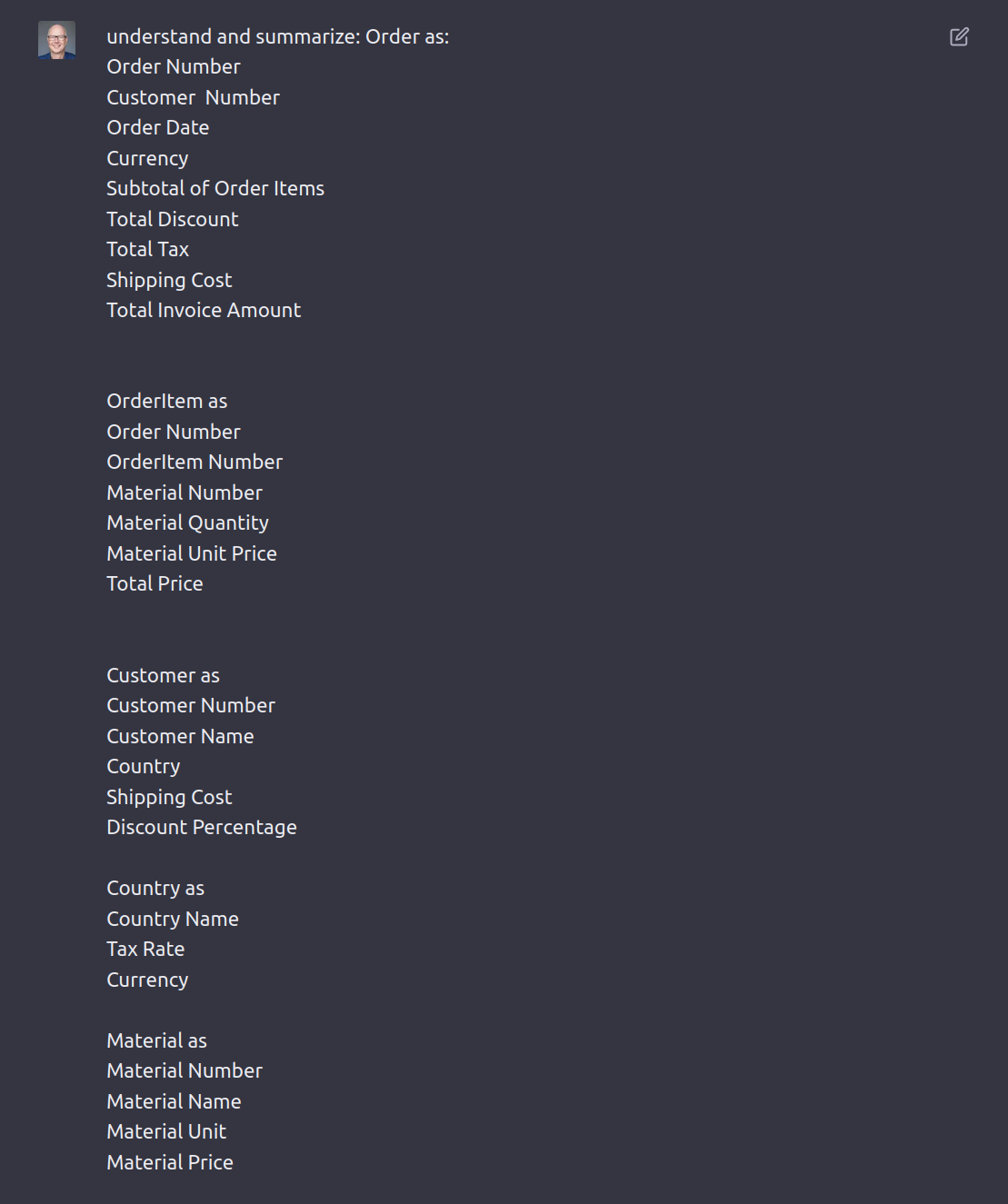
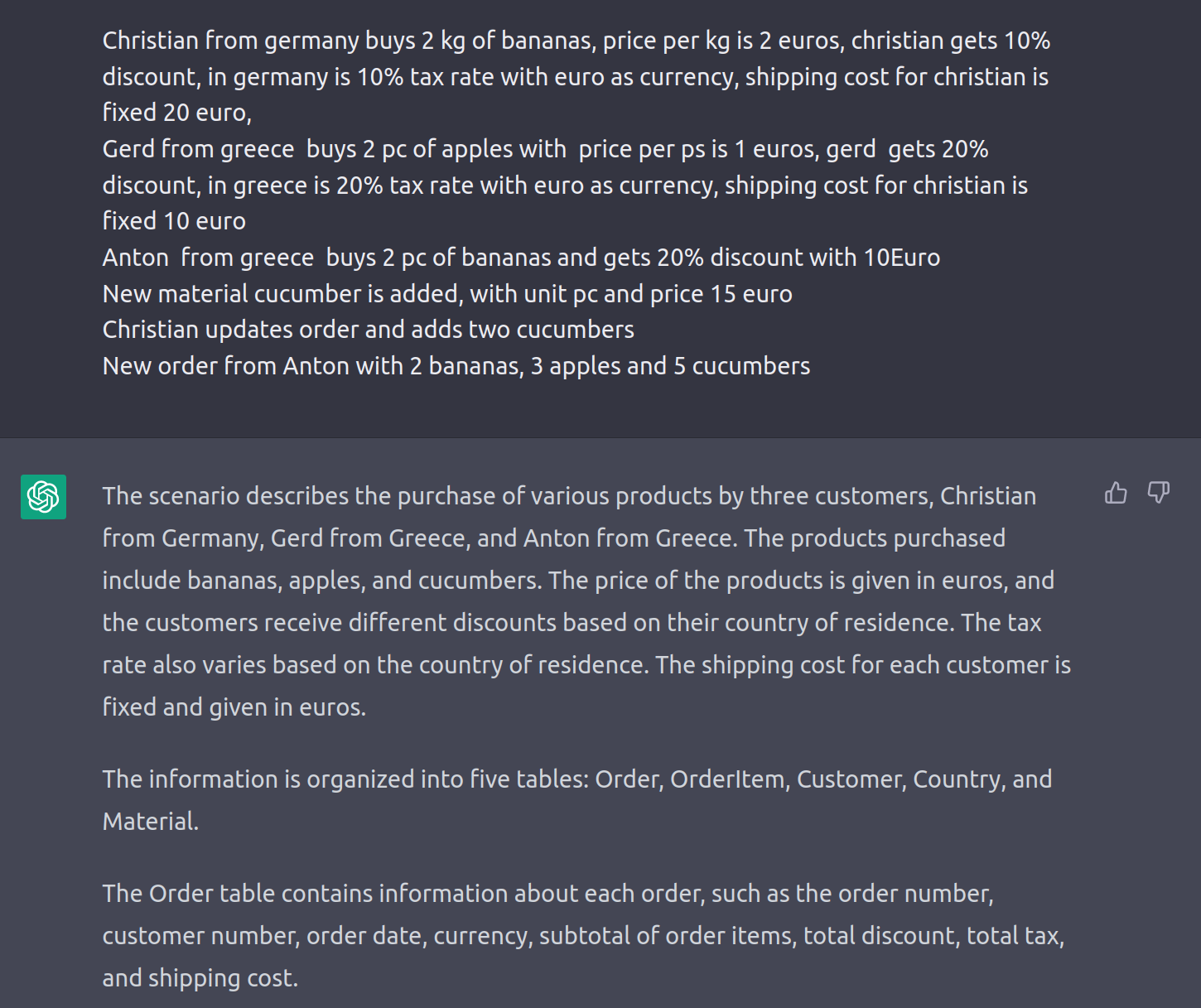
    The scenario I want to run is a simple sales process,  to start I am giving ChatGPT the prompt or initial context for our conversation. To let him understand  that we are talking about orders, order-items material and customers.

    But it could be any other scenario or  data structure.

    What does it mean?

    ChatGPT3 is a chatbot that can keep the context of a conversation, this are up to 4000 token (words can be 1-3 token). Once a conversation is longer than this token, he “forgets” the beginning token(FIFO), this is a setting is compromising performance and result quality. For our experiment that is enough.

    Enter Sales Transactions as “Free Text”

    I found blasting – I am providing free text information on some sale scenarios, just indicating what could be transactional or masterdata – and the KI puts this information in the right context and knows which of the free-text information belongs to which object (see next window for more details)

    What does it mean?

    When loading new information into any system –  this requires to understand the business context of the data and also the structure of the data in the DataLake / Database. In this scenario the “world knowledge” of ChatGPT made it understand the business context and the prompt information gave the structural information.

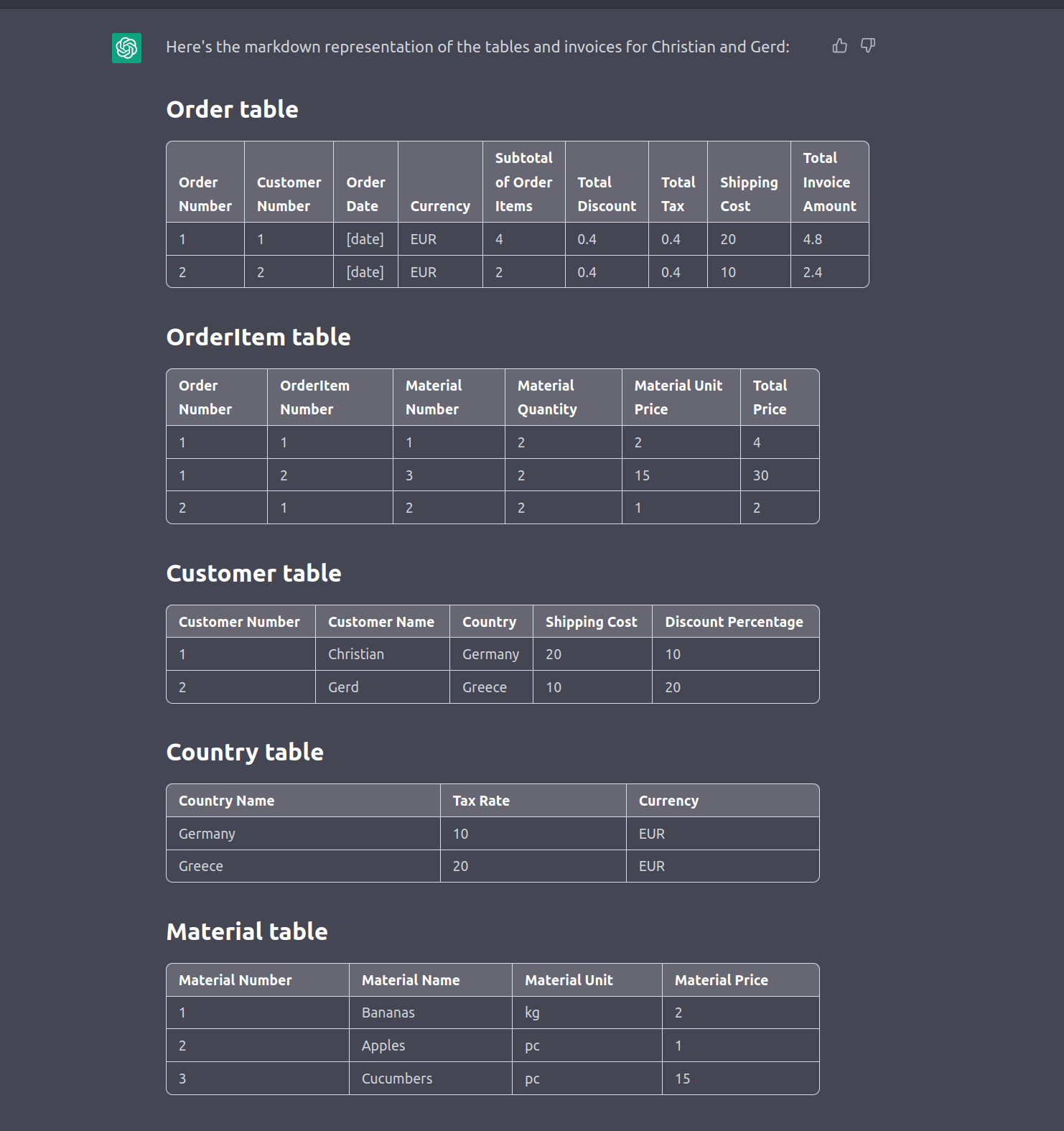
    Show me the tables!

    I asked ChatGPT to present this data in tables – to validate if it had the right understanding – just enjoy how this works.

    Its worth to notice that the concept of master-data is understood and even IDs a matching as needed for a relational database. I believe that happened as in my initial prompt was indicating a relational data structure.

    What this means?

    I tried some more scenarios, like “Christian buys the same again” – and it got right all the time – basically anybody with business context is able to load data into a lake. Considering ChatGP3 speaks multiple languages – its the concept of one interface to the data.

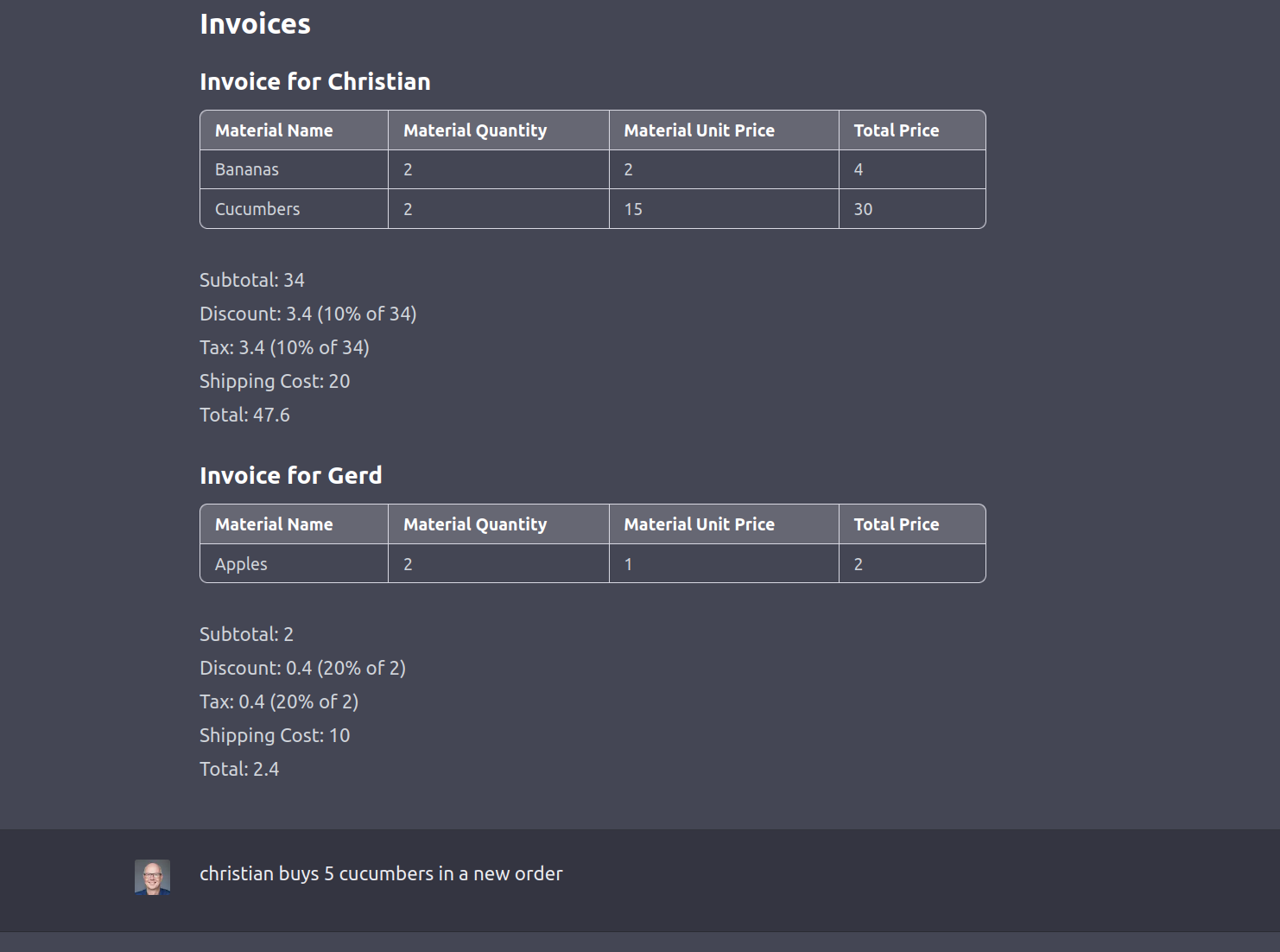
    Print an Invoice

    I asked to generate an invoice based on the information provided – and the results looks nice. In addition (in another chat) I asked to add certain details – and the invoice layout was adjusted.

    What does it mean?

    ChatGPT has “learned” a big part of the internet, it read “all books” and now has an memory that somehow represents the common thinking (in topics with a lot of reference material)

    This common standard was applied to the invoice, so the result is an invoice as -most- people would expect to see. This will not fulfill every bodies need, but a user could refine the layout and the logic in this conversation.

    Run the Analytics

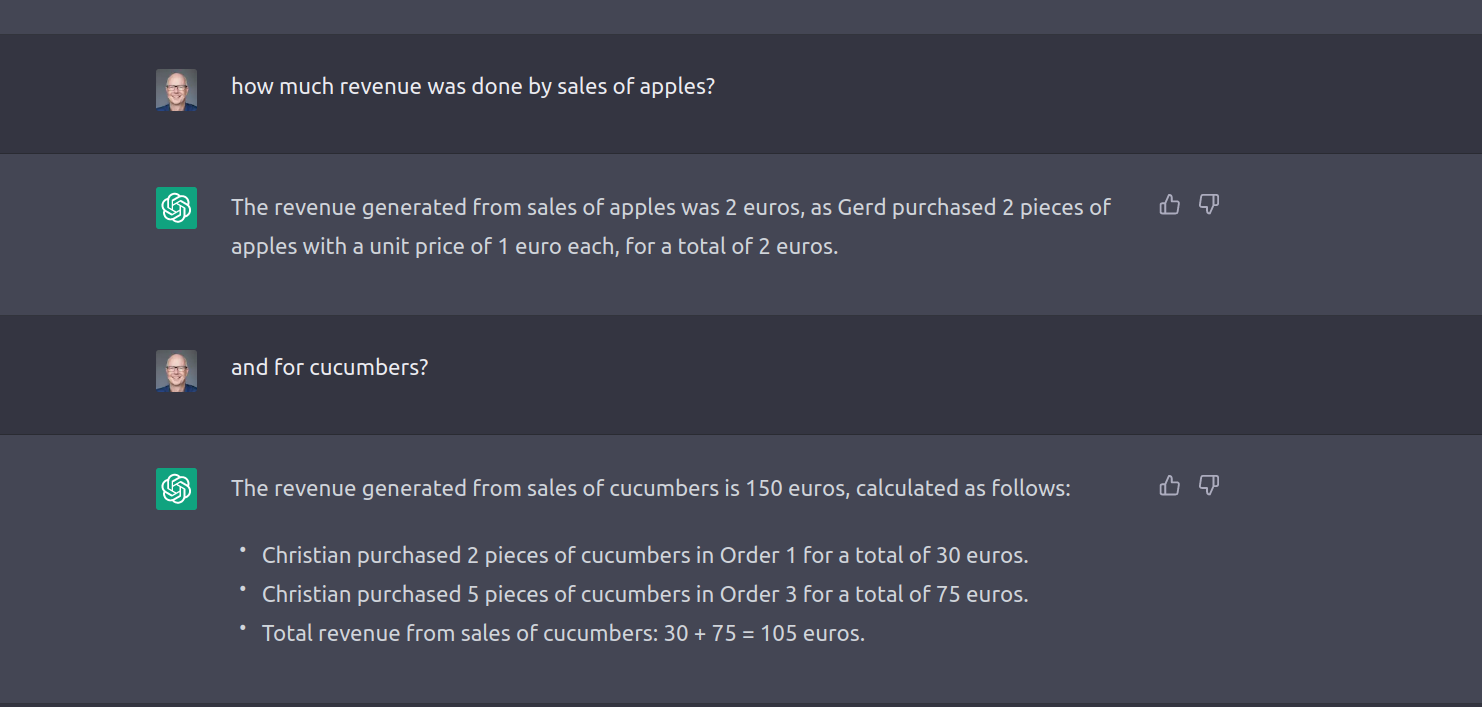
    I was interested on the revenue of my little business – so why not just asking for it.

    I tried other examples, “Revenue of Fruits” – if there would be regions –  you could ask “Revenue in EMEA” or “Total Tax sold on Bananas” – returned answers work out.

    What does it mean?

    As you see – the answer was provided , again “revenue” was not in the original data model – the answer was coming from the conversational context (data structure, sales information ) and the common knowledge.

    You will also notice, that there is explanation in the answer – that makes it better understandable how the results have been calculated. Its possible to ask more details on each step.

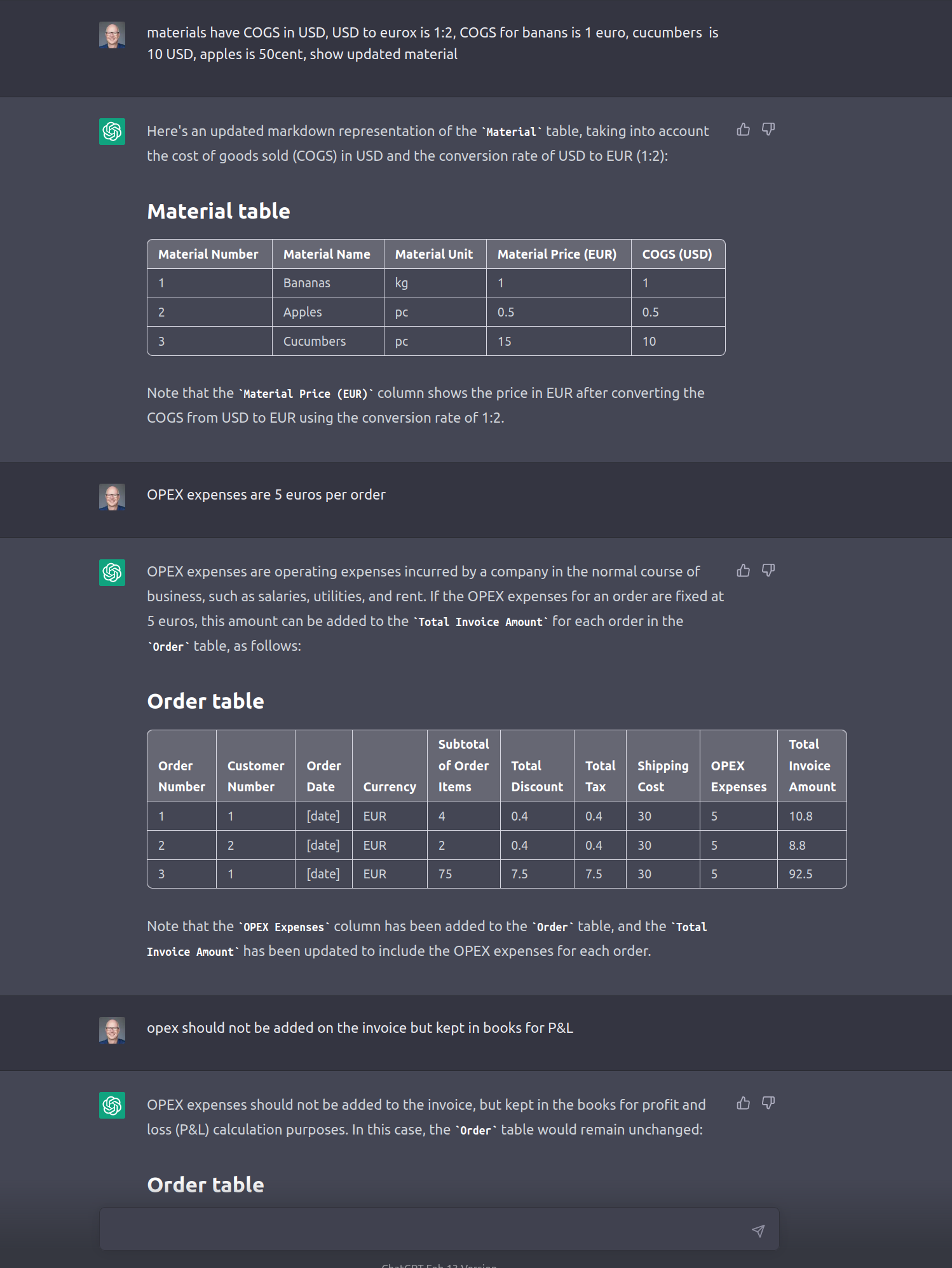
    Adding COGS and OPEX

    Moving away from sales to get my “Profit and Loss” – I needed to add COGS and OPEX calculation to my sales – this will require to add new data, but also requires updates in the data structures.

    What does it mean?

    One sentence “OPEX expenses are 5 Euros per order” resulted in 3 steps:

    1. adjusting the table structure
    2. calculating the values based on the formula
    3. updating the existing data

    This is already a small IT project 🙂

    ChatGPT is seeing data structure, content as “one input” –  hence it will try to keep all all above elements consistent and aligned. What is a difficult task in an analytics project comes naturally here.

    (*) Please note that this process does not really make full sense from financial perspective!


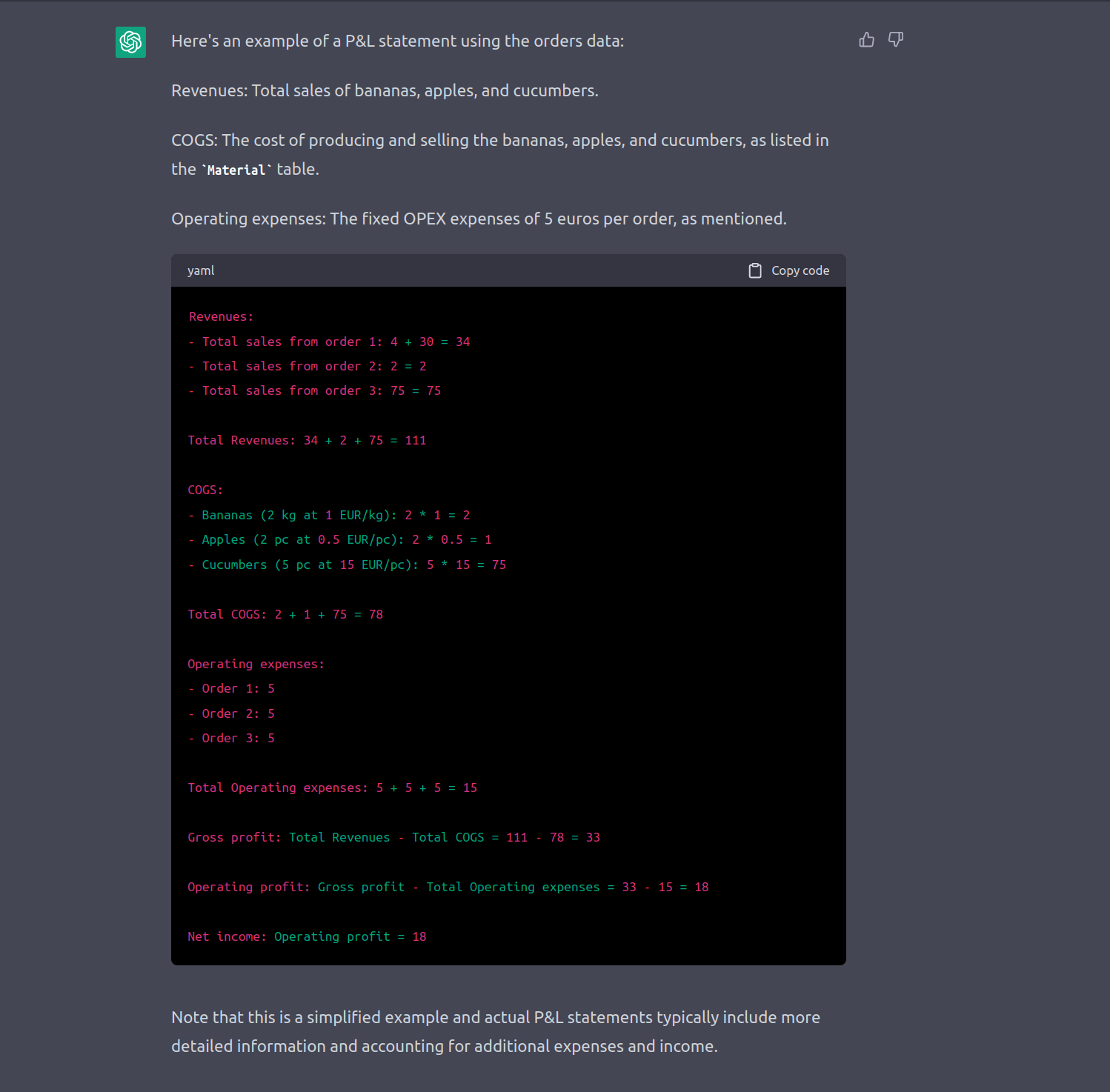
    Profit and Loss Statement

    I asked to get the P&L Statement – and got it.

    I tried without having COGS and OPEX – and ChatGPT complained – that is not enough to build a statement.

    What does it mean?

    Again this is a combination from world – knowledge and conversational knowledge. The interesting part is,that we moved from sales to finance and the data now is in a different context. Use of a database is not driven by its original design, but by the context and questions asked.

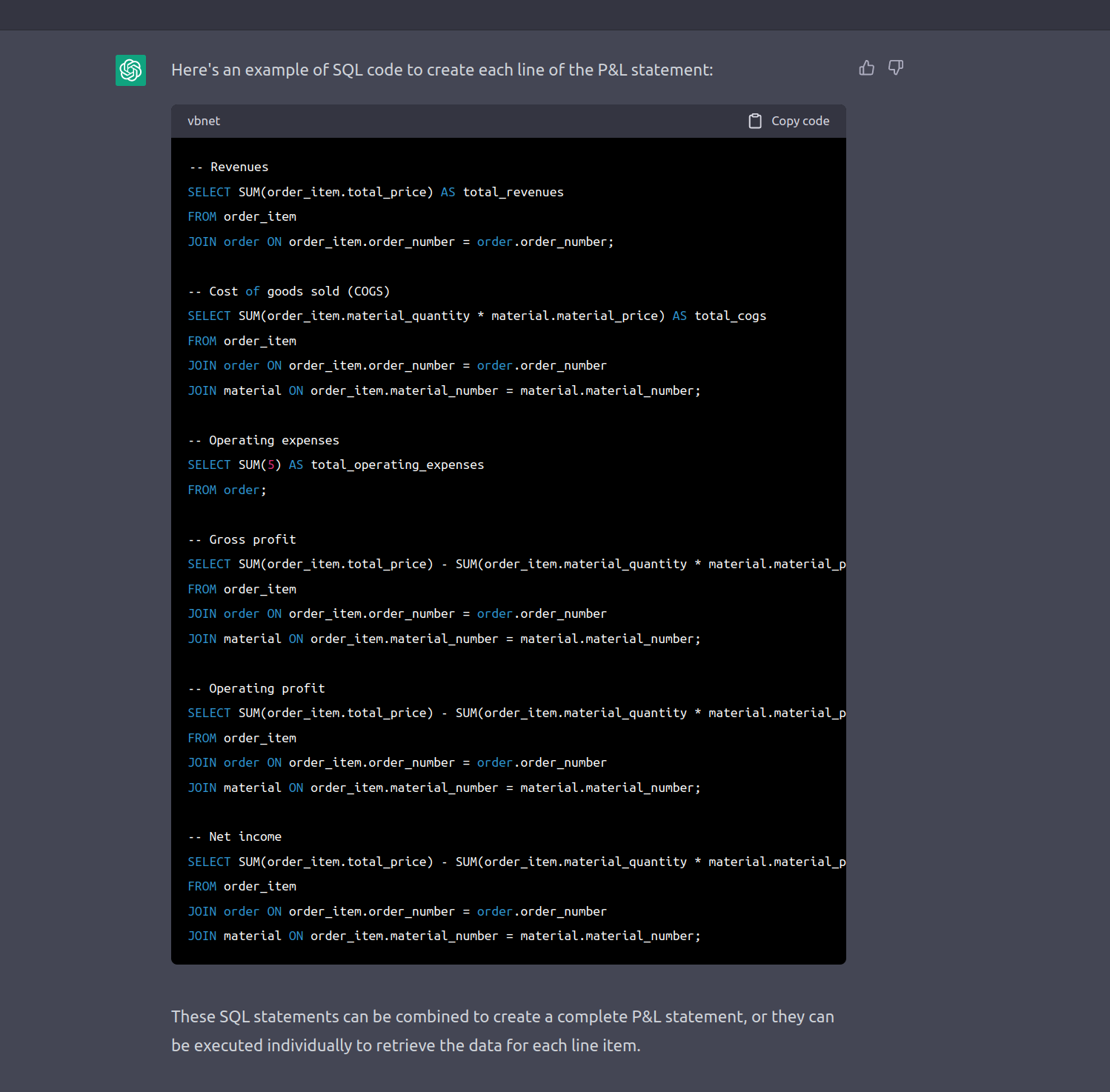
    Build and Application

    Because conversational knowledge is restricted, its a good idea to conserve it in code/sql statements. I must admit I did not check those statements. I did checks for other scenarios and I found the quality pretty good, some joins would have taken me a lot of time to build.

    What does it mean?

    SQL Statements or programs can be generated by ChatGPT and it is really, really good in it. That statements can be seen as the persisted knowledge – I way to get the outcome documented and re-useable. A normal user query can be just executed by ChatGPT, something like an P&L statement should be based on a fixed, approved set of statements. Both ways are possible.

    work of dalle-2

    BIG CHANGE AHEAD

    Revolutionizing Data and Analytics: Envisioning the Future of AI that Combines General and Domain-Specific Capabilities for Unmatched Power”

    Sam Altman, the CEO of OpenAI, envisions a near future where custom-built/individual AI will be common and can have custom characteristics or knowledge.

    I envision a domain specific Data and Analytics AI enriched with common world knowledge, that consists of three components:

    1. Validated common world understanding (common layer)
    2. Validated subject matter expert knowledge (e.g. validated finance rulesets, US GAAP, SEC, Medical Research).  This rulesets could be tailored to a scope (research area) , a process (sales) or an application, like SAP BW or CFIN.
    3. Prompt Knowledge: Understanding of the specific details of a data lake or structure, which provides the overall framework for storing the data and gives direction to build the overall design. Similar to the prompt that has been used in previous examples, the prompt could also be the knowledge of a legacy system that needs to be used.

    Companies will start selling these AI as bundles, combining 1. and 2. and helping the customer with setting up the prompt knowledge.

    AI is already used in analytics, and it is already possible to ask questions in natural language that get translated into a dashboard, but I believe this will be on a different level.

    Different Way of Working

    Working with these platforms will be different, more flexible, and with less cost for changes and updates. It will require distinguishing between repeatable/fixed information still boiled in a fixed structure and a spontaneous query by a user.

    It is not clear how the future will be, but it will not remain the same. Given the current speed of development and the huge impact of AI in Data and Analytics, it will change, with new tools and new ways of using/accessing data.

    When making significant investments in Data and Analytics, this revolution should be kept in mind.